
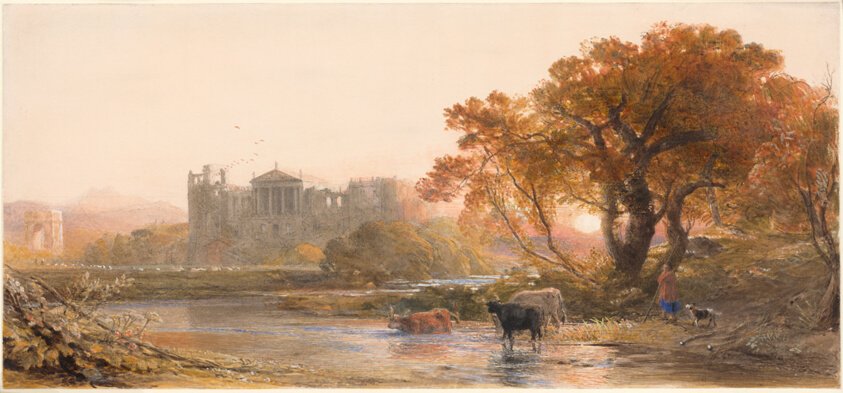
“Stop to appreciate this evocative watercolor, where the romantic grandeur of a deserted Italian villa meets the quiet beauty of a moonlit landscape. Its rich colors and intricate details create a powerful sense of mystery and the passage of time.”
A dramatic twilight scene unfolds in this watercolor, as a lone figure, perhaps a shepherd, guides a small flock of sheep past a crumbling, vine-covered villa. The sky is a vibrant tapestry of oranges and deep blues, suggesting the last gasp of daylight, while a full moon, almost a perfect circle, already casts its pale glow. The villa itself, with its classical columns and overgrown archways, speaks of a grand past now yielding to nature's embrace. This work, created in 1845, captures a sense of melancholic beauty, where human structures are slowly reclaimed by the wild, yet the enduring presence of the moon and the quiet activity of the shepherd hint at life's continuous cycle. It evokes a feeling of quiet contemplation on the passage of time and the romantic allure of ruins under a vast, luminous sky.
- Artist
- Samuel Palmer
- Date
- 1845
- Medium
- Watercolor, with traces of shell gold, over graphite on cream wove paper, perimeter mounted to cream wove card
- Location
- Art Institute of Chicago
- Dimensions
- 19 × 41.2 cm (7 1/2 × 16 1/4 in.)
- Collection
- Prints and Drawings
- Culture
- United Kingdom
- Credit line
- Gift of Celia and David Hilliard in honor of Jim and Emese Wood
What to Notice
Five details hide in plain sight. Here’s where to look.
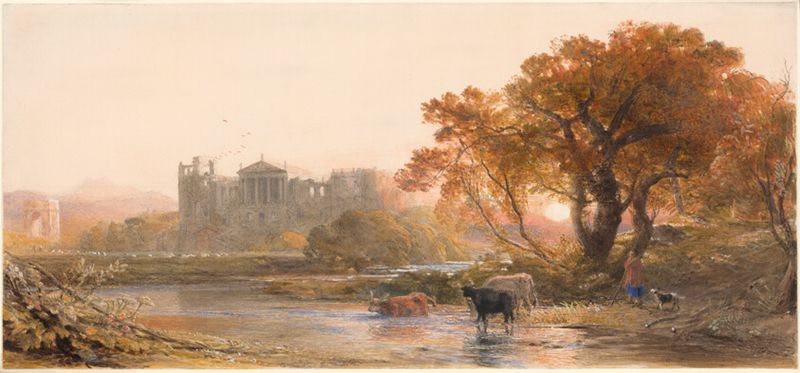
The glowing full moon, a luminous orb in the twilight sky.
The intricate detail of the crumbling villa's columns and archways.
The tiny shepherd and his flock, dwarfed by the landscape.
The rich, warm colors of the sunset blending into deep blues.
1 more detail is waiting.
See all 5 in Art Whisper →Stand in front of it and listen
The full narration walks you through Evening in Italy—the Deserted Villa — the story behind it, the details most visitors miss, and why it matters. Free in the Art Whisper app.
Samuel Palmer
Samuel Palmer transformed the Kentish landscape around Shoreham into a 'demi-paradise' of mysterious, visionary beauty.
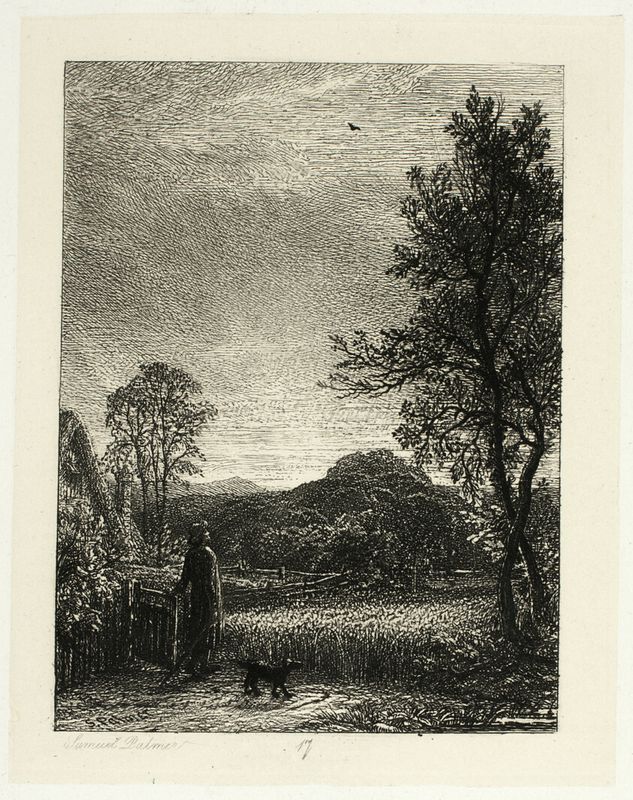
Further Works by Palmer

More works to explore
Beyond Palmer: works from the same years.
 Same era · 1830s–1860s
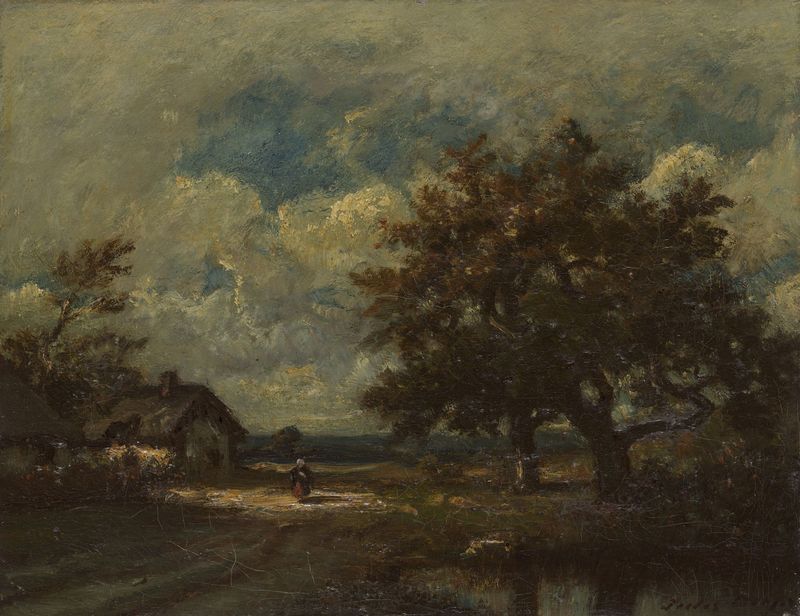
The Cottage by the Roadside, Stormy Sky
Léon-Victor Dupré · 1855 · Art Institute of Chicago
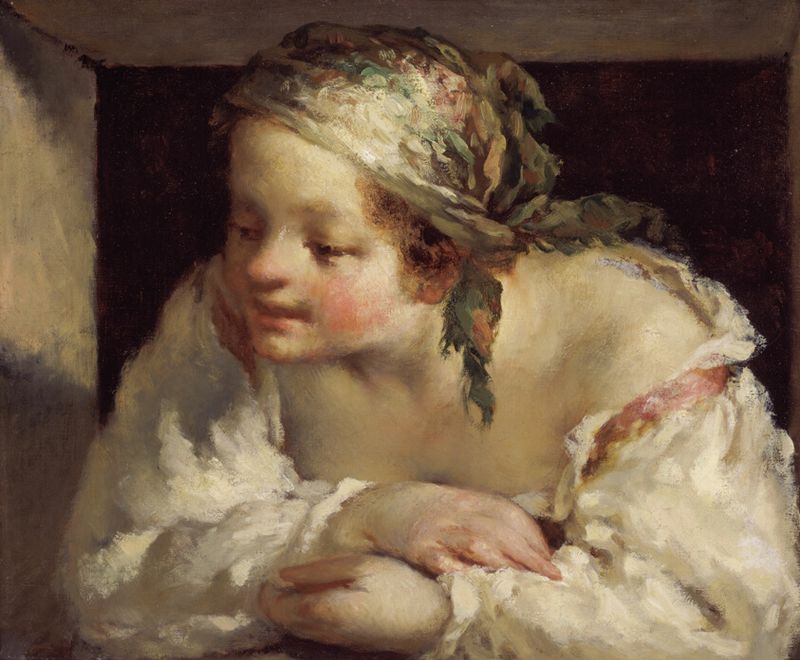 Same era · 1830s–1860s
Young Woman
Jean-François Millet · 1844 · Art Institute of Chicago
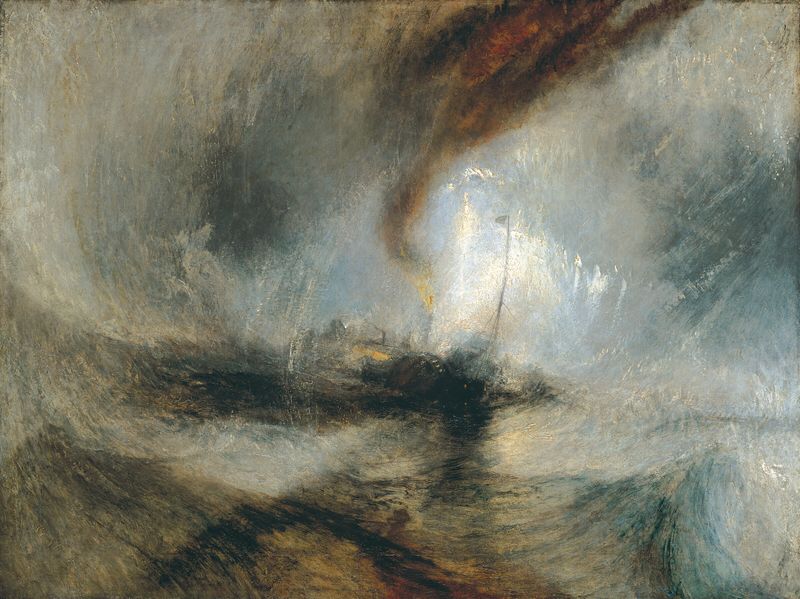 Same era · 1830s–1860s
Snow Storm: Steam-Boat off a Harbour's Mouth
J. M. W. Turner · 1842 · National Gallery
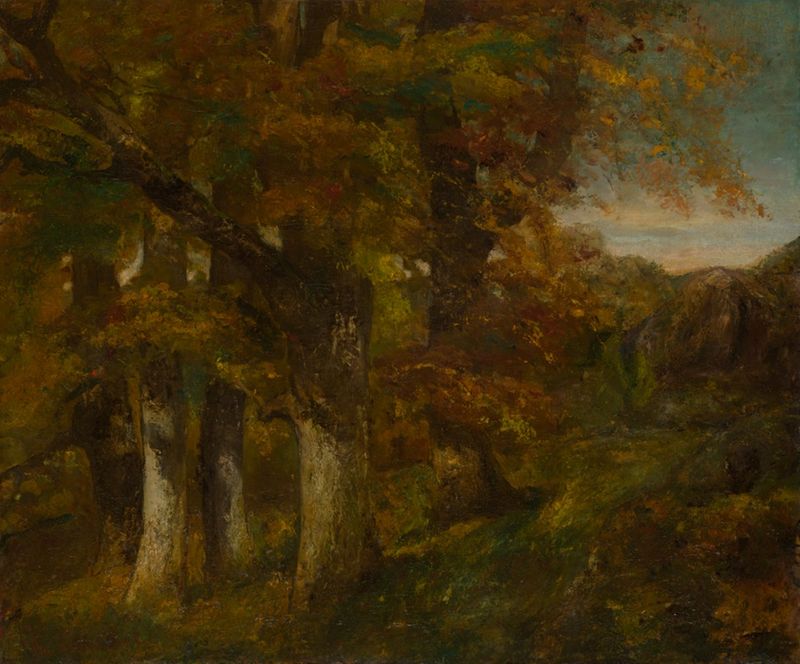 Same era · 1830s–1860s
Wooded Landscape
Gustave Courbet · 1848 · Art Institute of Chicago
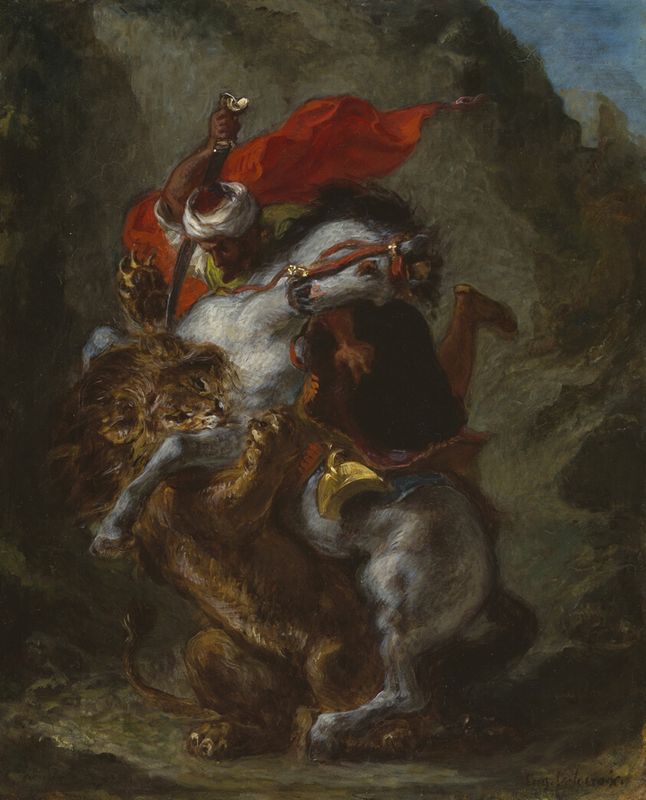 Same era · 1830s–1860s
Arab Horseman Attacked by a Lion
Eugène Delacroix · 1849 · Art Institute of Chicago
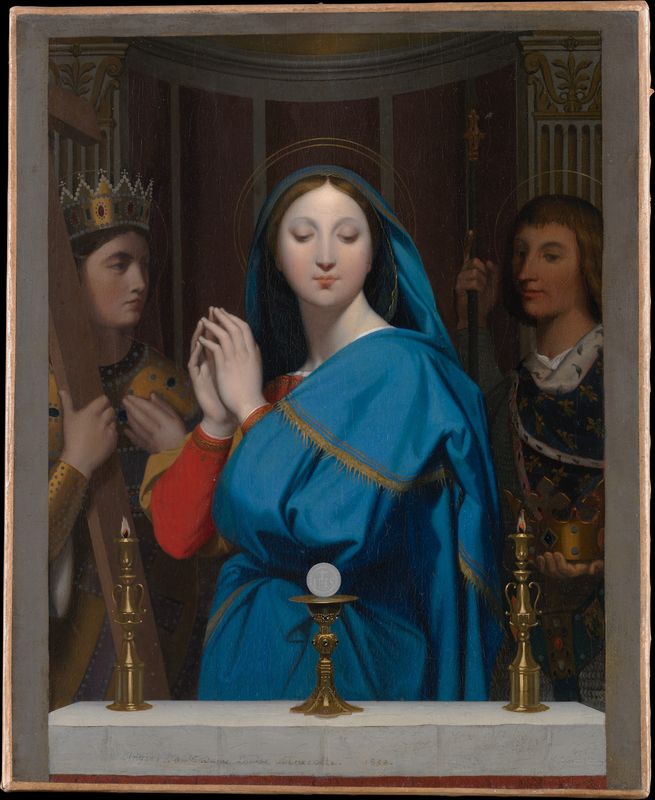 Same era · 1830s–1860s
The Virgin Adoring the Host
Jean-Auguste-Dominique Ingres · 1841 · Pushkin Museum of Fine Arts
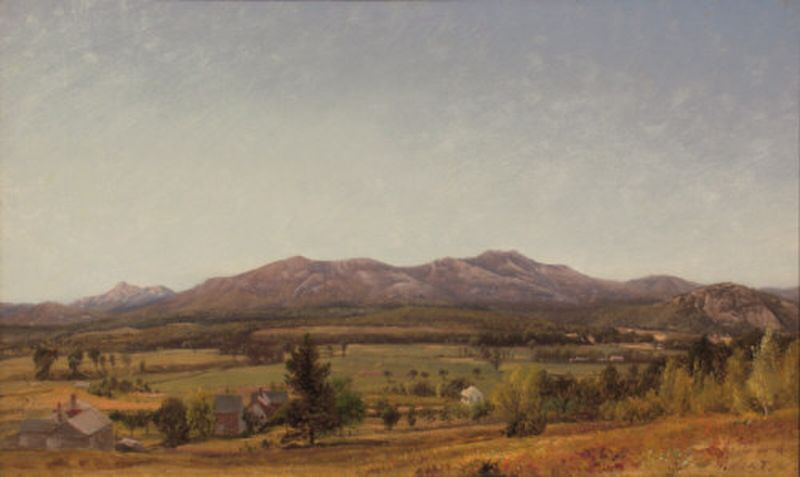 Same era · 1830s–1860s
Mount Chocorua and Moat Mountain from North Conway
William Hart · 1850
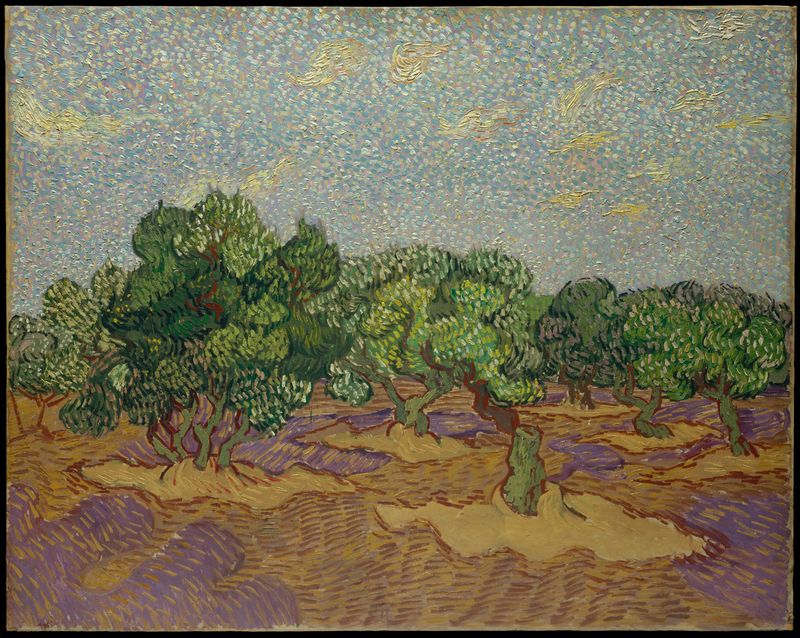 Same era · 1830s–1860s
Olive Trees
Vincent van Gogh · 1853 · The Metropolitan Museum of Art
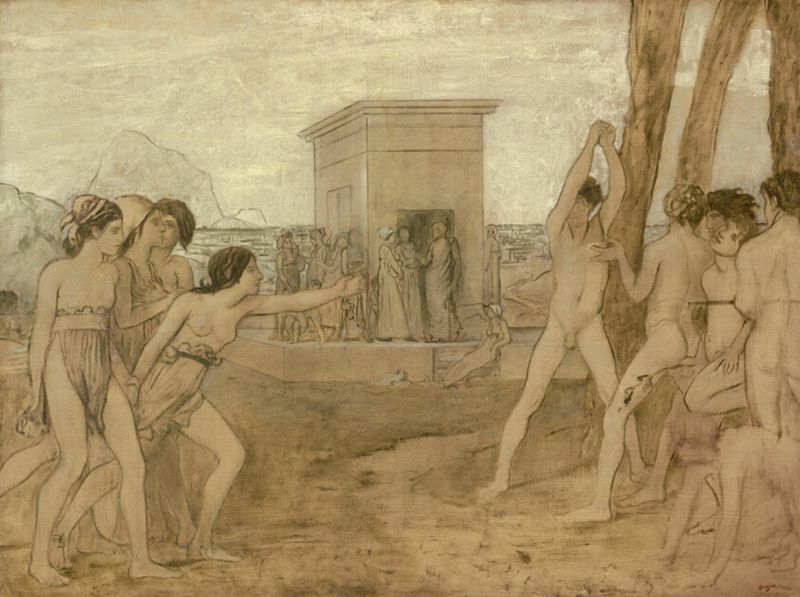 Same era · 1830s–1860s
Young Spartan Girls Challenging Boys
Edgar Degas · 1860 · Art Institute of Chicago
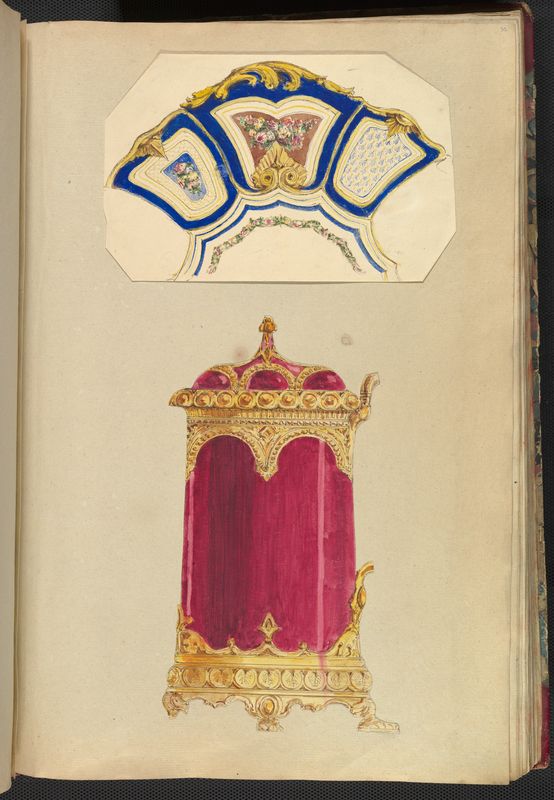 Same era · 1830s–1860s
Designs for a Decorated Dish, or Platter, and a Biscuit Barrel
Alfred Henry Forrester [Alfred Crowquill] · 1845 · The Metropolitan Museum of Art
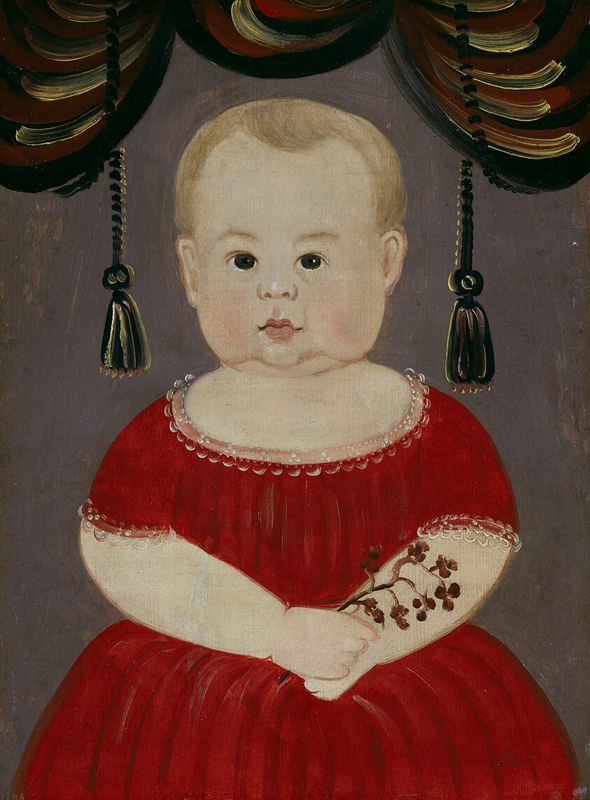 Same era · 1830s–1860s
Portrait of Fred Adelbert Haywood
School of William Matthew Prior · 1848 · Art Institute of Chicago
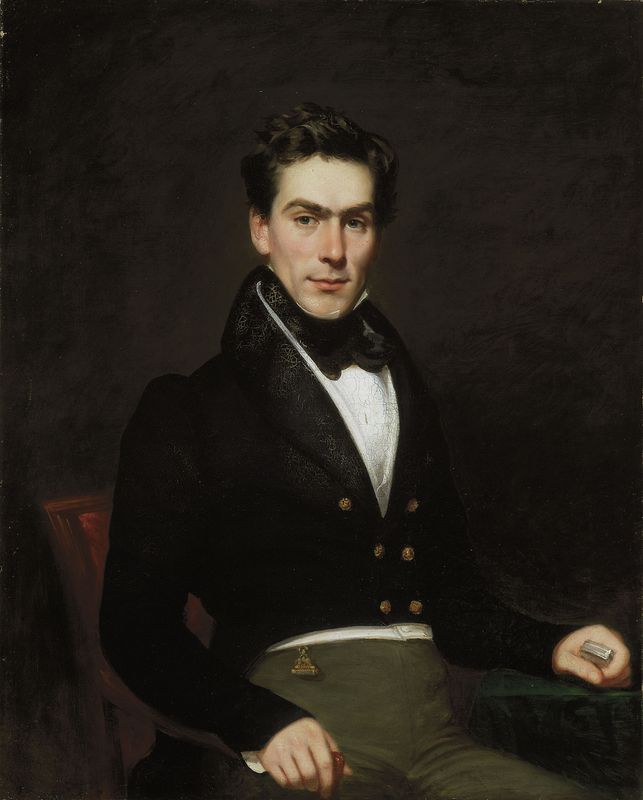 Same era · 1830s–1860s
Mr. James Mackie
Samuel Alcock & Company · 1830 · Art Institute of Chicago