
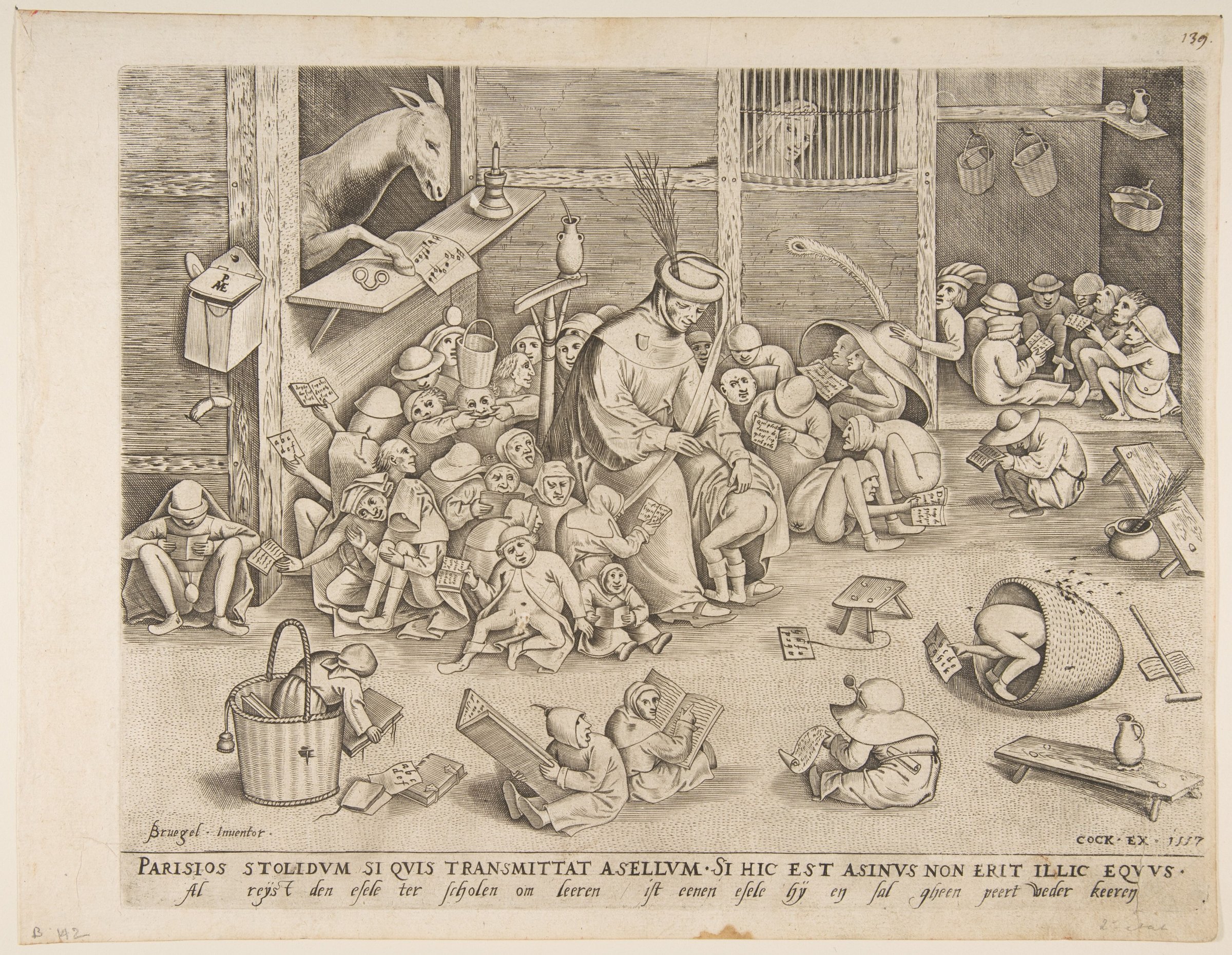
“This engaging print by Pieter Bruegel the Elder uses a comical scene of a donkey in a classroom to poke fun at the idea that mere attendance can impart wisdom. Look closely at the details to discover its subtle humor and timeless message about learning.”
In this bustling engraving, a donkey stands at the center of a lively schoolroom, surrounded by human pupils. The scene is a satirical commentary on the futility of forcing education upon those unwilling or unable to learn. While the children eagerly engage with their lessons, reading from books and pointing to slates, the ass remains oblivious, tethered and wearing a dunce cap. Its presence, a literal interpretation of the Dutch proverb "even an ass goes to school to learn," highlights the idea that attendance alone does not guarantee wisdom. Bruegel, working in Antwerp, then a hub for printmaking, designed this image for Hieronymus Cock's publishing house in 1557. The detailed composition, filled with everyday objects and a variety of characters, invites viewers to ponder the nature of intelligence and the limits of formal instruction. This work exemplifies the Northern Renaissance tradition of moralizing genre scenes, using humor to convey a deeper truth.
- Artist
- Pieter Bruegel the Elder
- Date
- 1557
- Medium
- Engraving
- Location
- The Metropolitan Museum of Art
- Dimensions
- plate: 9 5/16 x 11 15/16 in. (23.7 x 30.3 cm)
- Collection
- Drawings and Prints
- Credit line
- Harris Brisbane Dick Fund, 1928
What to Notice
Five details hide in plain sight. Here’s where to look.
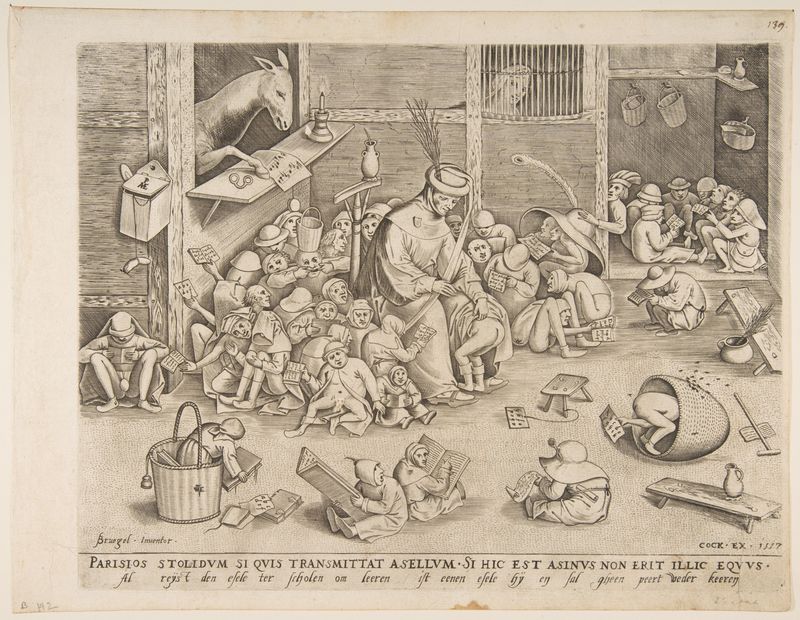
The donkey's expression, or lack thereof, as it stands among the students.
The dunce cap on the donkey's head, a clear sign of its role in the satire.
Children diligently studying, some with open books, others pointing to lessons.
Everyday schoolroom details: quills, inkpots, and a teacher at a desk.
1 more detail is waiting.
See all 5 in Art Whisper →Stand in front of it and listen
The full narration walks you through The Ass at School — the story behind it, the details most visitors miss, and why it matters. Free in the Art Whisper app.
Pieter Bruegel the Elder
1525–1569 · Duchy of BrabantPieter Bruegel the Elder pioneered large-scale landscapes and peasant scenes, profoundly influencing Dutch Golden Age painting.
Further Works by Elder
 The Fight Between Carnival and Lent
1559
 The Tower of Babel
1563
 Large Alpine Landscape
1550 · The Metropolitan Museum of Art
 The Kermis at Hoboken
1554 · The Metropolitan Museum of Art
 The Descent of Christ Into Limbo
1556 · The Metropolitan Museum of Art
 The Thin Kitchen
1563 · The Metropolitan Museum of Art
 The Land of Cockaigne
1570 · The Metropolitan Museum of Art
 The Rich Man Playing Violin on a Jaw Bone
1528 · The Metropolitan Museum of Art
More works to explore
Beyond Elder: works from the same years.
 Same era · 1540s–1570s
Diana and Actaeon
Titian · 1557 · National Gallery
 Same era · 1540s–1570s
The Meeting of Jacob and Rebecca, and Isaac Blessing Jacob from The Story of Jacob
Workshop of Jan van Tieghem · 1560 · Art Institute of Chicago
 Same era · 1540s–1570s
Close Helmet
Pompeo della Cesa · 1560 · The Metropolitan Museum of Art
 Same era · 1540s–1570s
Ornamento delle belle & virtuose donne, page 6 (recto)
Matteo Pagano · 1554 · The Metropolitan Museum of Art