“This ancient Egyptian statuette of Re-Horakhty, a falcon-headed god, offers a direct connection to the religious beliefs and artistic craftsmanship of over three millennia ago. Its detailed inscription and powerful stance reveal its significance in ancient worship.”
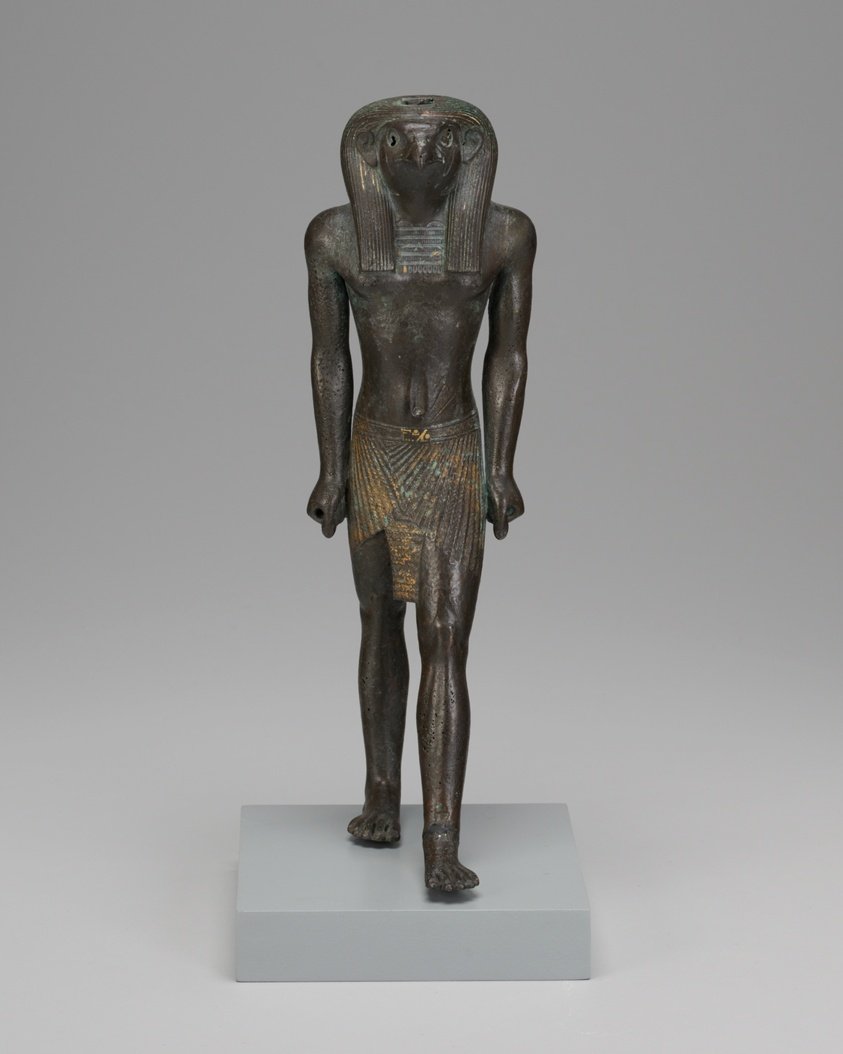
This striking copper alloy statuette depicts Re-Horakhty, a powerful combination of the sun gods Re and Horakhty, striding forward with a falcon's head. Although the sun disk that would have crowned his head is now missing, you can still see the small hole where it was once inserted, emphasizing his solar identity. Look closely at his belt, and you'll find golden hieroglyphs that declare his status: "Re-Horakhty, Chief of the Gods." Such statuettes were not just decorative; they served a vital religious function, placed in temples and shrines to receive offerings or as gifts to the gods, sometimes later buried in ceremonial caches. This figure, with its commanding posture and divine attributes, offers a tangible link to ancient Egyptian worship practices, particularly in cities like Iunu (Heliopolis), where Re-Horakhty was especially revered.
- Artist
- Ancient Egyptian
- Date
- -1069
- Medium
- Copper alloy with gilding
- Location
- Art Institute of Chicago
- Dimensions
- 25 × 8.3 × 10.5 cm (9 7/8 × 3 1/4 × 4 1/8 in.)
- Collection
- Arts of Africa
- Culture
- Egypt
- Credit line
- Gift of Henry H. Getty, Charles L. Hutchinson, and Robert H. Fleming
What to Notice
Five details hide in plain sight. Here’s where to look.
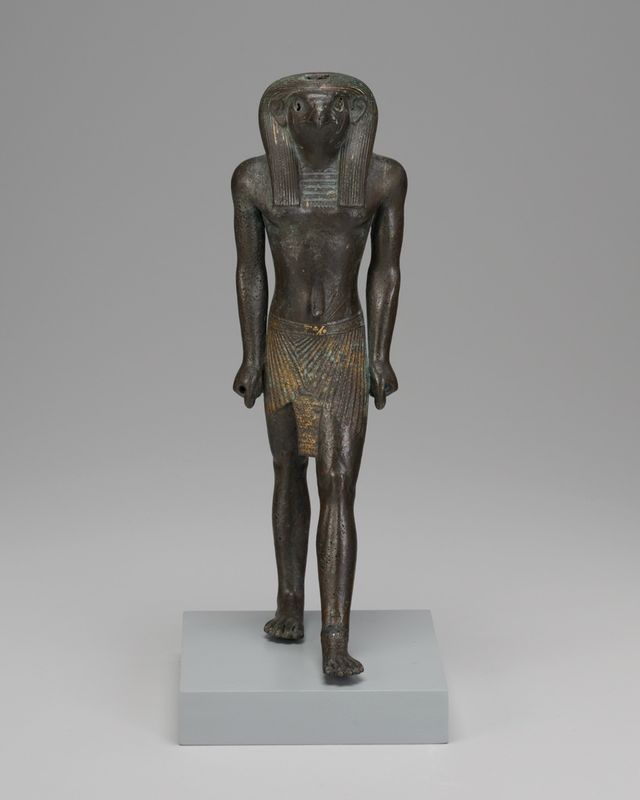
The falcon head, identifying Re-Horakhty.
The small hole at the top of the head, where a sun disk once rested.
Golden hieroglyphs on the belt, reading "Re-Horakhty, Chief of the Gods."
The forward-striding pose, conveying movement and power.
1 more detail is waiting.
See all 5 in Art Whisper →Stand in front of it and listen
The full narration walks you through Statuette of Re-Horakhty — the story behind it, the details most visitors miss, and why it matters. Free in the Art Whisper app.